
How to Accept Pix in Brazil Without a Local Entity


You’ve probably seen the term Merchant of Record (or “MoR,” for short) thrown around quite a bit. And while it may seem like a rather commonplace concept in the already acronym-filled eCommerce space, the truth is, very few people truly understand what a MoR really is and why it’s such a critical component to get right when running an online business. In this blog post, we’ll provide a brief overview of what a MoR is, the two primary MoR operating models businesses can adopt, and the relative pros and cons of each model.
Ensuring strict compliance with PCI-DSS standards for protecting cardholder information and adhering to all local, regional, and global data security regulations.
Ensuring strict compliance with PCI-DSS standards for protecting cardholder information and adhering to all local, regional, and global data security regulations.
1. Be your own Merchant of Record
As an online business, you are legally obligated to act as your own MoR by default. This means you are required to tackle all of the administrative tasks mentioned above on your own.
The first thought you may have is that this all sounds like a big headache. It can be, especially if you don’t know your way around the global payment processing ecosystem. However, there still may be times when you’re still better off operating as your own MoR:
The long story short: if you’ve got the right resources in house and have a limited sales footprint and sell in a single currency only being your own MoR is doable. It’s just not always easy navigating the complex payment, tax, and regulation landscape on your own. This is oftentimes the reason why many online businesses opt for option number two.
2. Partner with a reseller as your Merchant of Record
If you weren’t able to say “yes” to any of the bullet points above, then you are most definitely in need of a partner who can manage all aspects of being a MoR on behalf of your online business.
This is especially true if you plan to sell across borders, as MoR responsibilities grow exponentially with every additional currency, country, or region you transact in. In fact, as your business expands globally, this is what your MoR responsibilities will be:
Opening international merchant accounts to accommodate regional payment methods, including country-specific credit cards like Carte Bancaire, Carte Bleue, Maestro UK, Visa Debit, MasterCard Debit, and the list goes on.
Staying on top of global sales tax calculation which can vary significantly by state, county, and city in the United States or can face constantly changing regulations, as is the case for VAT in the European Union collection, and remittance, latter of which involves filing taxes for each jurisdiction you transact in.
Without a Merchant of Record, you will need to handle various aspects of payment processing, tax management, and regulatory compliance by yourself. This may involve dealing with the complexities of setting up and managing relationships with payment gateways, acquiring banks, and other financial institutions.
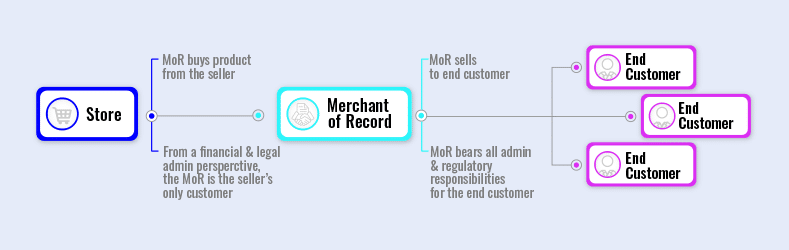
A Merchant of Record (MoR) bears full financial responsibility for its business customers, whilst Payment Service Providers (PSPs) simply process the payments. The PSPs enable the payments without any additional liabilities, meaning that a selling business is still responsible for administrative tasks such as compliance, security, and payment disputes, which can instead be delegated to a MoR, such as Nexway.
The Seller of Record (SoR) is another separate and critical player in the transactional process within the e-commerce landscape. The SoR undertakes the responsibility of handling legal and financial matters associated with a transaction, ensuring adherence to laws and tax obligations. While having some characteristics in common with the Merchant of Record, the Seller of Record might have a more limited scope in terms of legal and financial aspects, leaving other responsibilities like payment processing and order fulfillment to other parties.
When businesses use Stripe to process payments for regular direct transactions, the business itself remains the MoR while Stripe acts as a payment processor or payment gateway. This means that the business is responsible for transactional compliance, tax obligations, and managing refunds and chargebacks while Stripe handles the technical aspects of transaction processing..
Nexway has been serving as Merchant of Record for online businesses for over 20 years. We manage full payment operations, including checkout user experience, taxes, and currencies, allowing you to prioritize product development and go-to-market strategies. From payments monitoring to global taxation and compliance, Nexway evolves with you to create the perfect custom fit for each solution we deliver.


